The mind is not a vessel to be filled, but a fire to be kindled.
The Foundation of Tazkiyah
Tazkiya and Personal Development
An Islamic Worldview Understanding the Self. Strengthening the Soul. Living with Purpose.
At The Ivy House Secondary School for Girls, every pupil’s character formation is at the centre of her education. Our Tazkiyah and Personal Development curriculum is the school’s structured commitment to forming young women whose souls are cared for as carefully as their academic learning.
We believe that the greatest educational question is not simply What do I know? but Who am I becoming?
The word Tazkiyah means purification, growth and refinement. It is the lifelong process of understanding ourselves, developing noble character, strengthening our relationship with Allah and striving towards excellence in every aspect of life.
The Forgotten Foundations
When many people think of Islam, they think first of rules, laws and obligations. Whilst these are essential, the Qur’an itself teaches us that personal transformation comes first.
Of the 114 Surahs of the Qur’an, approximately 86 were revealed in Makkah before the establishment of the Muslim community in Madinah. These Makkan revelations focused primarily on faith, belief, purpose, character, self reflection, accountability, the Hereafter and the relationship between the individual and Allah. The remaining Madinan revelations provided detailed guidance regarding worship, family life, society, law and governance.
This reveals a profound educational principle:
• Allah transformed hearts before He transformed society.
• Allah built character before He established law.
• Allah nurtured faith before He revealed governance.
The Qur’anic method began by developing the individual before developing the community. Today, many young people know how to navigate technology, social media and modern society, yet struggle to navigate themselves. They understand how to connect to the world but often find it difficult to understand their own identity, emotions, purpose and direction.
•If we do not understand ourselves, how can we understand our place in the world?
•If we do not understand what drives our thoughts, desires and decisions, how can we make wise choices?
•If we do not cultivate the heart, how can we fulfil our purpose?
Our Tradition: Imam Al Ghazali and the Ihya Ulum al Din
Our curriculum draws its principal inspiration from Imam Abu Hamid Al Ghazali, may Allah have mercy on him, born in Persia in 1058 and recognised as one of the most influential scholars in the Sunni Islamic tradition.
He held the most prestigious teaching post of his age at the Nizamiyyah in Baghdad before leaving public life to spend years in study, reflection and spiritual renewal. From this journey emerged his most famous work, the Ihya Ulum al Din (The Revival of the Religious Sciences), a work that has shaped Muslim hearts and minds for more than nine centuries.
The Ihya is a comprehensive guide to the inward life of the believer. Across its four great quarters, Imam Al Ghazali teaches worship, the customs of daily life, the diseases of the heart that must be removed and the virtues that must be cultivated. His educational method remains as relevant today as it was nine hundred years ago.
Spiritual growth begins with: Takhalli
Removing harmful traits and diseases of the heart. Tahalli
Adorning oneself with noble character and virtue.Tajalli
The tranquillity, clarity and closeness to Allah that emerge from a purified heart. This framework shapes our curriculum across all five years
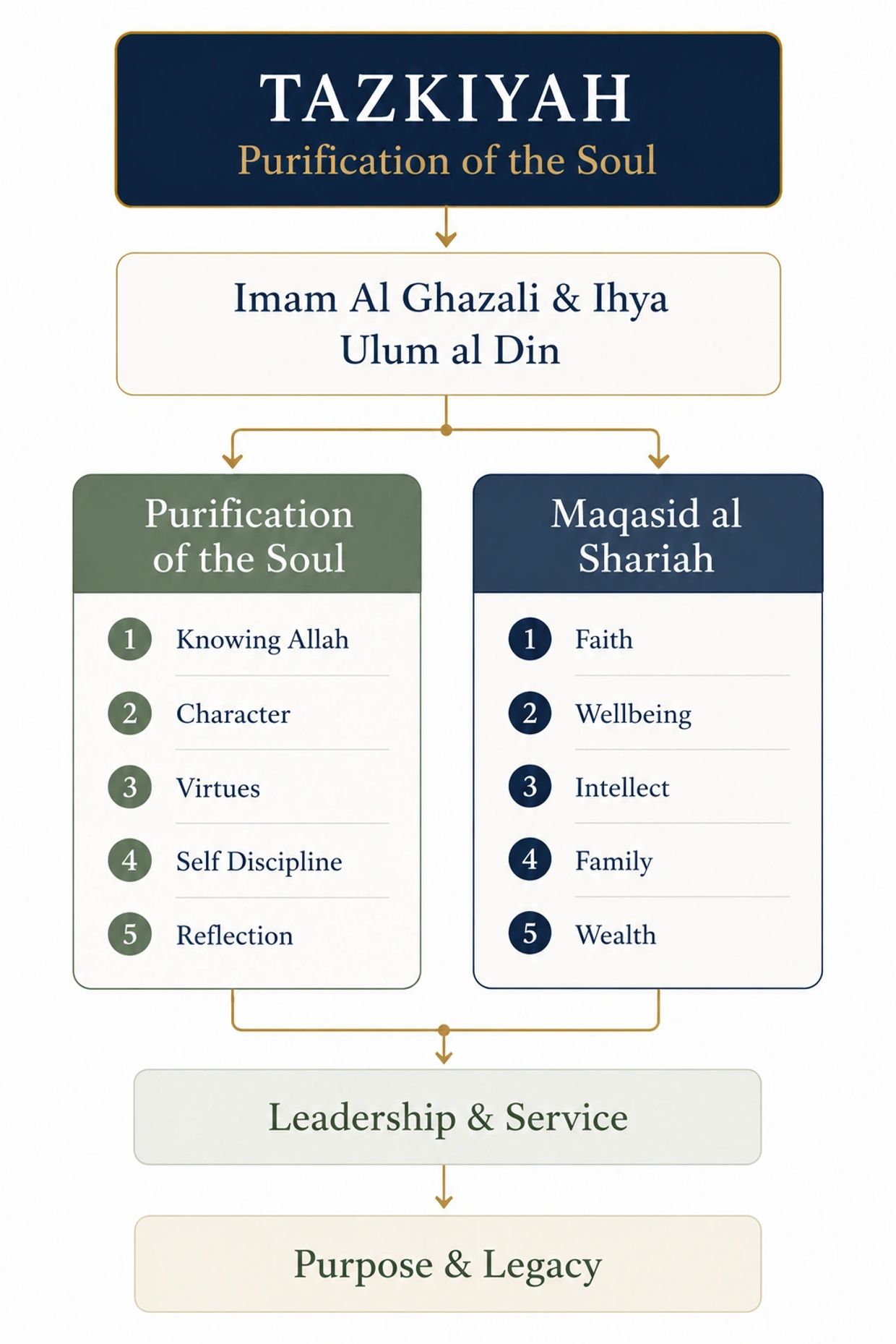
Our Framework: Tazkiyah and Maqasid al Shariah
Our curriculum is built upon two complementary traditions within Islamic scholarship.
The first is the work of Imam Al Ghazali and the Ihya Ulum al Din, which focuses upon purification of the heart, character formation and spiritual development.
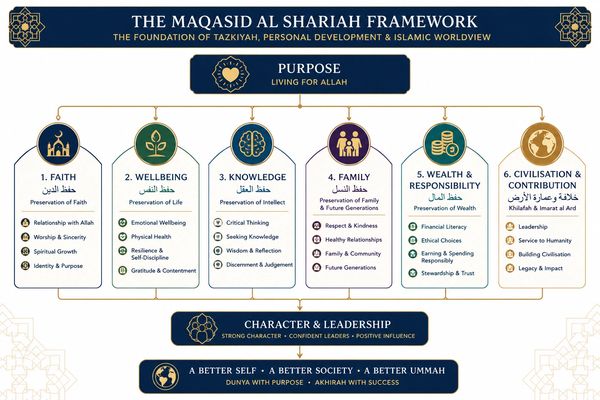
The second is the Maqasid al Shariah, the higher objectives of Islamic guidance, articulated and systematised by Imam Al Ghazali in his foundational work Al Mustasfa.
Together they help students develop both inward excellence and outward responsibility.
The Five Maqasid
Faith (Hifz al Din)
Cultivating a strong relationship with Allah through worship, sound belief, qualified scholarship and spiritual resilience.
Wellbeing (Hifz al Nafs)
Caring for physical health, emotional wellbeing, personal safety and resilience.
Knowledge and Wisdom (Hifz al Aql)
Developing intellect, critical thinking, discernment, reflection and a lifelong love of learning.
Family and Relationships (Hifz al Nasl)
Grounding students in dignity, family life, healthy relationships, community and belonging.
Wealth and Responsibility (Hifz al Mal)
Teaching financial literacy, ethical decision making, stewardship and responsibility.
Our Curriculum Journey
Big Question
Year 7 Knowing Yourself: Who am I?
Year 8 Character and Relationships:
Who am I becoming?
Year 9 Society and Worldview:
How should I live?
Year 10 Leadership and Responsibility:
What impact will I have?
Year 11 Purpose and Legacy :
What will I leave behind?
Across these five years students explore identity, faith, character, relationships, wellbeing, worldview, leadership, responsibility, service and legacy through an Islamic framework rooted in the Qur’an, Sunnah, Imam Al Ghazali and the Maqasid al Shariah.
Our Purpose: Khulafa fil Ard
These five protections serve a greater purpose.
Allah describes humanity as Khulafa fil Ard , vicegerents and stewards upon the earth.
Human beings were not created merely to exist, consume or pursue personal success. They were created to know Allah, worship Him and contribute positively to His creation.
Before a young person can decide what career to pursue, where to study or how to live, she must first understand who she is and why Allah created her. The question of identity therefore precedes the question of achievement.
At The Ivy House School for Girls, students are encouraged to see themselves not simply as learners, but as future mothers, professionals, scholars, innovators, leaders and contributors who carry a responsibility towards Allah, their families, their communities and the wider world.
How We Teach
Each lesson incorporates:
• A Qur’anic verse
• A Prophetic teaching
• A teaching from Imam Al Ghazali
• Reflection and personal application
Students maintain a personal reflection journal throughout their five years, enabling them to record their learning, personal reflections and spiritual development.
The female Companions of the Prophet ﷺ including Khadijah al Kubra, Aishah al Siddiqah, Fatimah al Zahra, Asma bint Abi Bakr and Umm Salamah, may Allah be pleased with them all, are studied throughout the curriculum as examples of faith, scholarship, leadership and service.
An Enquiry Driven Curriculum
Students explore meaningful questions such as:
• Why did Allah create me?
• What makes a heart alive?
• Who is shaping the way I think?
• What diseases can destroy the heart?
• How do I strengthen my character?
• What does true success look like?
• How can I fulfil my role as a Khalifah of Allah on earth?
• What kind of Muslim woman do I want to become?
Statutory Coverage
Every safeguarding, personal development and relationships requirement contained within KCSIE and Department for Education statutory guidance is delivered through this Islamic framework rather than alongside it.
Students encounter these protections as Islamic protections, understood through the language, ethics and wisdom of their own tradition.
Developing Women of Faith, Character and Purpose
Our aim is not simply to prepare students for examinations.
We seek to cultivate young women who know who they are, understand why Allah created them and are prepared to fulfil their responsibilities as servants of Allah and Khulafa fil Ard.
• When the heart is nurtured, the mind is enlightened.
• When the mind is enlightened, character is strengthened.
• When character is strengthened, purpose becomes clear.
Through Tazkiyah and Personal Development, students embark upon a journey of self discovery, spiritual growth and character formation rooted in the Qur’an, the Sunnah, the scholarship of Imam Al Ghazali and the framework of the Maqasid al Shariah.
Our ambition is to develop young women who possess faith with conviction, knowledge with wisdom, character with integrity and purpose with direction.
Framework